


Plants against property
Corporate scaremongering, plants and property
by Sarah Keenan
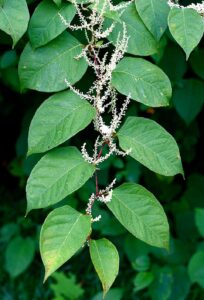
In my research, I have found that people love talking about Japanese knotweed, without fully recognising how corporate and financial institutions have transformed public perceptions of it. In Britain, the plant is popularly understood as a kind of bogeyman figure. It is something people are frightened of, but which poses no real or imminent threat. Japanese knotweed is no more physically hazardous than many other forms of vegetal life that attract no comparable stigma. Yet the fear is real: the existence of Japanese knotweed on an owner’s property has been listed as the reason for suicide in the deaths of two homeowners in the English midlands.
Where has this fear came from? Though it’s impossible to pinpoint the causal root of a national emotion, the closest answer I can find is a 2007 internal memo at Abbey National (now Santander).
The plant’s life and story in Britain starts earlier. Its evolution as an ‘othered’ form of life began with its objectification as a specimen of colonial botany, taken from Japan by a Dutch-East India army officer and from there propagated and sent out to much of Europe including to Kew Royal Botanical Gardens, a key imperial institution. Records from Kew show the plant arriving from Leiden in 1850. From there, it was sold to commercial nurseries striving to meet the ‘insatiable demand for novelty’ of British gardeners in this era. As well as being admired for its exotic beauty, Japanese knotweed was admired for its hardiness. Its roots were rumoured to be capable of binding sandbanks, and chosen by some as a forage plant for cattle. Landowners bought it to increase what property law terms the ‘amenity value’ of land – the enjoyment to be gained from possessing it.
But as it was sent out to the large estates of the landed gentry, Japanese knotweed grew disobedient. As A.P Conolly, a botanical expert on this plant in the British Isles writes, ‘Japanese Knotweed was not long content to remain in gardens and, from the beginning of the century, increasing numbers of escapes were reported.’ The plant is hardy, reproducing asexually through its rhizomes, and capable of sprouting new life from small fragments in soil. By the 1930s, the plant was falling out of favour with gardeners and those who sold to them. As the plant continued to grow, attitudes toward it hardened, and it became the subject of legal regulation and prohibition. In 1981 Japanese knotweed was listed as one of only two proscribed land plants in the Wildlife and Countryside Act. This made it an offence to ‘cause to grow’ the plant ‘in the wild.’ The Environmental Protection Act 1990 listed the plant as ‘controlled waste’ making it an offence to deposit, treat, keep or dispose of without a licence.

But the real alarm started in the 2000s, when mortgage lenders grew scared. In his submission to the 2019 House of Commons Science and Technology Committee into the effects of Japanese knotweed on the built environment (HC 1702), surveyor and RICS Fellow Philip Santo cites a June 2007 internal memo at Abbey National (now Santander) as raising concerns about the plant. The memo expressed the need for some form of indemnity, guarantee or insurance to mitigate the lenders’ risk when affected land was used as security. The decision to require specific risk mitigation or else refuse the loan was circulated to all surveyors working for Abbey National. It required them to increase their awareness of the plant. Other lenders soon followed suit. This led to, as Santo puts it, a ‘vicious circle which still largely colours public perception and directly affects property values’…‘even when the valuer is aware of evidence that Japanese Knotweed poses no physical risk to most dwellings, a valuation must still reflect the market impact of the public perception of the risk, even if that perception is inaccurate.’
The timing of the memo is worth noting. With the global financial crisis, risk appetites amongst lenders began to change. In Britain, this was a period of peak mortgage-assisted homeownership, led by neoliberal government policy encouraging owner-occupation as the flip side to cuts to the welfare state. The British population was (and still is) heavily financially invested in their homes. As the real estate market rose sharply at the end of the 20th century, owners’ homes became their most significant asset and the one most heavily leveraged. Within this financial climate, anything that threatens the value of homes causes alarm.
With Abbey National deciding that the plant was of especially high risk – and this decision impacting the surveying industry – the Royal Institute of Chartered Surveyors (RICS) tried in 2012 to help its members to assess this risk by creating a protocol, with rules to categorise risk levels for any property from which the plant could be seen growing. The Law Society subsequently updated its TA6 form, which all sellers complete as part of the preparatory paperwork for a conveyance, to include a new question in the section on ‘Environmental matters’ devoted to the presence of Japanese Knotweed. In addition to questions on flooding, radon and energy efficiency, the form now also asks whether the property is affected by this one specific plant. At the same time, the tabloid media described the plant as a threat to national security using thinly veiled racist language.
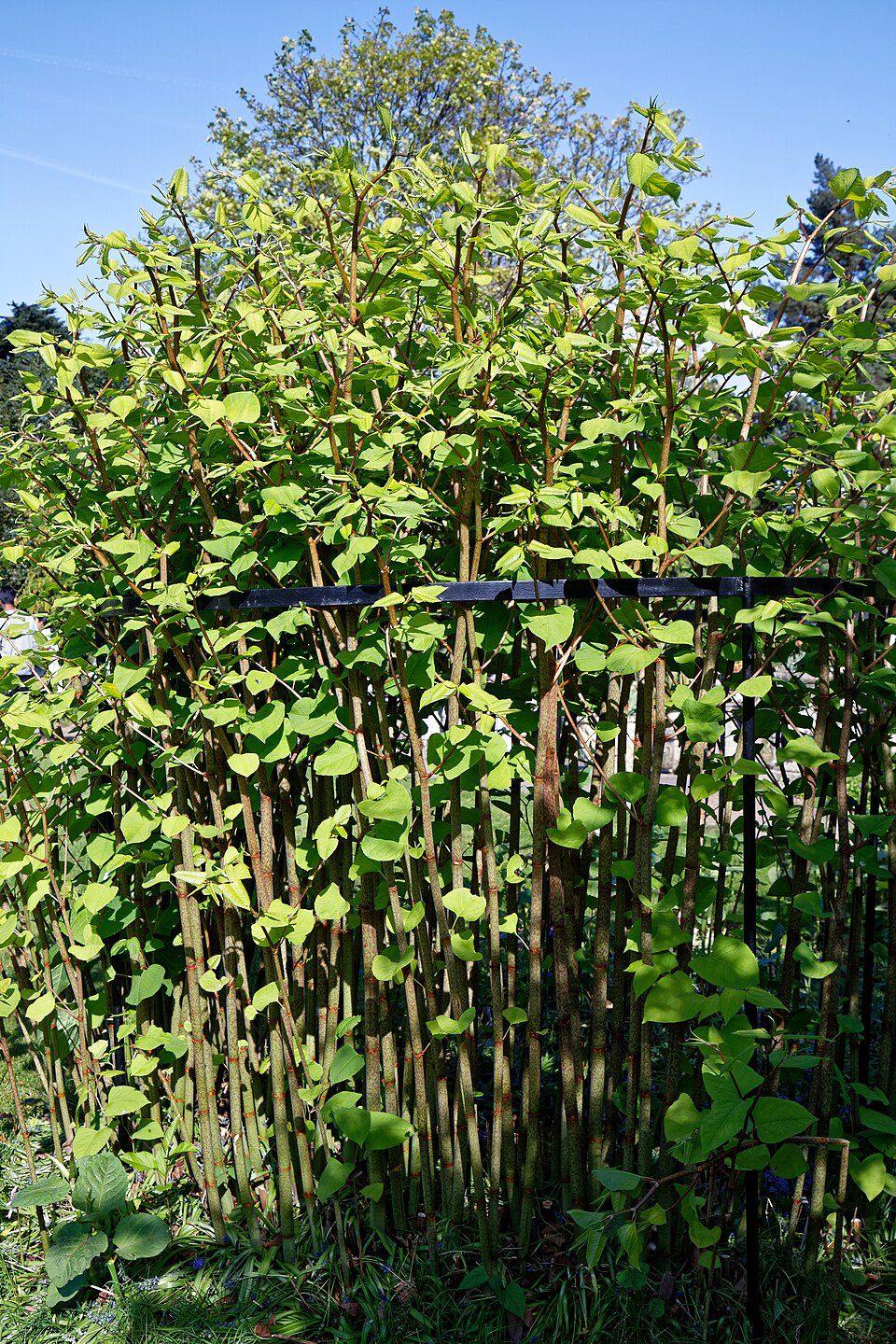
This has led to the situation we have today. British landowners are right to fear Japanese knotweed, not because it will damage their land, but because it will reduce its value. In my recent article, Plants Against Property: Japanese knotweed as companion species, I argue that thinking through Japanese knotweed as companion species offers a radical ecological critique of property. By making land unsellable, Japanese knotweed forces that land to be used as habitat and resource rather than market commodity. The plant’s refusal to die when targeted by humans also inverts the human subject-controls-nonhuman-object conceptual paradigm upon which dominant understandings of property rest. Outsmarting the descendants of its colonial captors, Japanese knotweed destabilises human-centred understandings of value, life and land. It invites new modes of being and relating in the more-than-human world. Perhaps by rethinking this plant and the fear it evokes, we can rethink not just property but the broader question of what we value, and of what threats might be more worthy of our collective attention.