


Santa Marta: transition by necessity
From transition by choice to transition by necessity
by Stefanie Khoury

Over 5 days in April, the city of Santa Marta, Colombia and The Netherlands co-hosted the First Conference on Transitioning Away from Fossil Fuels (TAFF). It brought together 57 states and over 1500 civil society members committed to developing concrete strategies for fossil fuel phase‑out. Fossil fuels – coal, oil and gas – are the largest contributor to global climate change, estimated at 68% of global greenhouse gas emissions and nearly 90% of all carbon dioxide emissions.
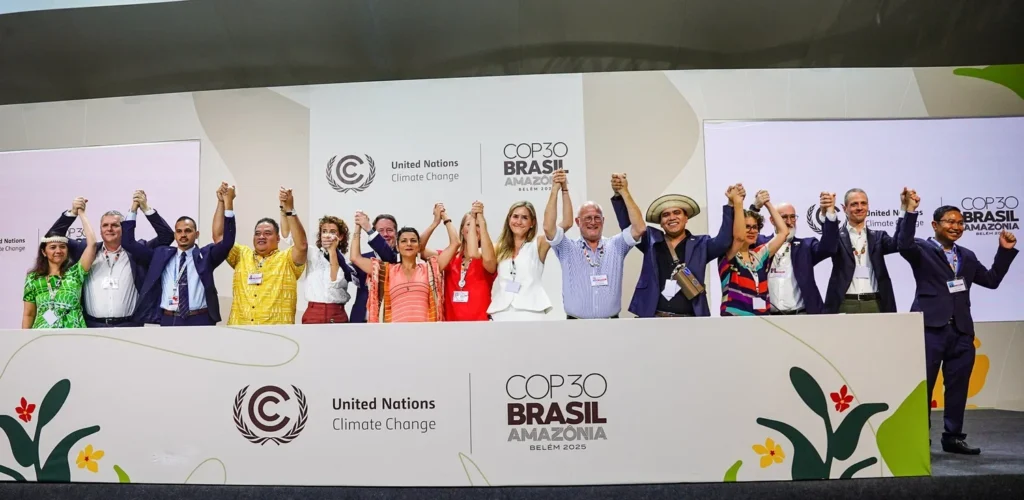
TAFF should be understood less as a momentary initiative than as a response to long‑standing disillusionment with the established forum. COP30, which became known as the ‘most divisive COP’ was a fiasco. Despite over 80 delegations coalescing around demands for a clear roadmap to fossil‑fuel phase‑out building on the global stocktake or GST adopted at COP28, the momentum ultimately failed to translate into substantive commitment following ongoing, concerted resistance from petrostates and other major economies. The final text omitted any reference to fossil‑fuel phase‑out.
The TAFF is not an out and out rejection of the UN climate forum, but an attempt to develop norms and commitments outside its institutional constraints, with the aim of eventually feeding them back into the UNFCCC, which is still the most likely, though deeply contested, site through which treaty status could be formalised.
In addition to creating a new space for climate diplomacy, the TAFF defines itself through its commitment to action and has been called a new way forward with “coalitions of doers”. The conference’s website frames its core purpose as responding to the question of how to transition away from fossil fuels, implicitly distancing itself from a COP process that has remained trapped at the level of persuasion and diagnosis, rather than delivery. There are three main pillars to the TAFF:
- Overcoming economic dependence
- Transforming supply and demand
- Advancing international cooperation and climate diplomacy

The agenda calls for reducing economic and energy dependence through fairer international financial structures, inclusive transition strategies, and shared global responsibility. It emphasises transforming energy systems by rapidly cutting fossil fuel demand, scaling up clean electrification, ensuring equitable access to energy, and managing a responsible decline of fossil fuel production. It also argues that international climate governance must move faster and beyond declaratory commitments, strengthening action‑oriented cooperation that challenges fossil fuel expansion and phases out Investor-State Dispute Settlement (ISDS) mechanisms that obstruct climate action.
While the TAFF’s three pillars engage with many of the core challenges of transitioning away from fossil fuels, persistent North-South asymmetries risk re‑inscribing structural injustices despite the invocation of justice‑oriented processes. To its credit, the Santa Marta initiative explicitly seeks to disrupt these dynamics through a co‑hosting model that pairs a Global South and Global North counterpart. This institutional design signals an important effort to rebalance agenda‑setting power and redistribute diplomatic visibility. In this respect, the 2027 Conference co‑hosted by Tuvalu and Ireland is particularly significant, as it both symbolically and materially recentres frontline states and loss‑and‑damage realities. For Pacific Island nations facing existential threats from climate change, fossil fuel phase‑out is not a matter of policy preference but of survival. This reframing shifts the narrative from transition by choice to transition by necessity, strengthening claims grounded in just transition, equity, historical responsibility, and the need for corresponding legal and institutional innovation.
Moreover, historical experience suggests that when initiatives led by the Global South begin to attract participation from the Global North, the very asymmetries they seek to contest often reassert themselves, resulting in dilution, stalling, or substantive reconfiguration. This trajectory is well illustrated by UN’s long history of business and human rights initiatives – the latest being the Treaty on Business and Human Rights, initiated by Ecuador and South Africa, which has been progressively weakened as Global North states – including the EU and USA – entered the process. While such participation has frequently been celebrated as a marker of legitimacy or progress, it may also signal a process of co‑optation, through which transformative demands are reshaped to align with existing commercial, legal, and geopolitical interests. For the TAFF, the risk lies in the pattern whereby initiatives that move toward binding obligations become absorbed into existing power hierarchies, with participation by powerful Global North actors serving less as a pathway to enforcement than as a mechanism through which transformative potential is moderated or neutralised.
The power imbalances embedded in legal authority, financial capacity, and geopolitical influence can derail this initiative for sure. These structural imbalances are most clearly entrenched in the international investment regime, and especially ISDS, that functions as a disciplining legal architecture that constrains states’ ability to pursue fossil fuel phase‑out without exposure to significant financial liability. The challenge for TAFF is not only to ensure that its procedural innovations move beyond symbolic partnership into material redistribution and enforceable obligations, but also to contribute to the far more demanding task of reshaping the international legal and financial architecture that continues to entrench fossil fuel dependence. Advancing toward such structural transformation will neither be linear nor easy, but it is precisely this longer‑term horizon that gives the initiative its wider significance.