The fight for the Hudson River

The fight to save New York’s Hudson River

by Samira Homerang Saunders

The US courts have given the green light to dump 45 thousand gallons of radioactive wastewater into New York’s  Hudson River.  This decision has gone relatively unnoticed in the media, yet it is potentially catastrophic for all life around the river and threatens to wipe out the historic gains made by environmental campaigners in New York.

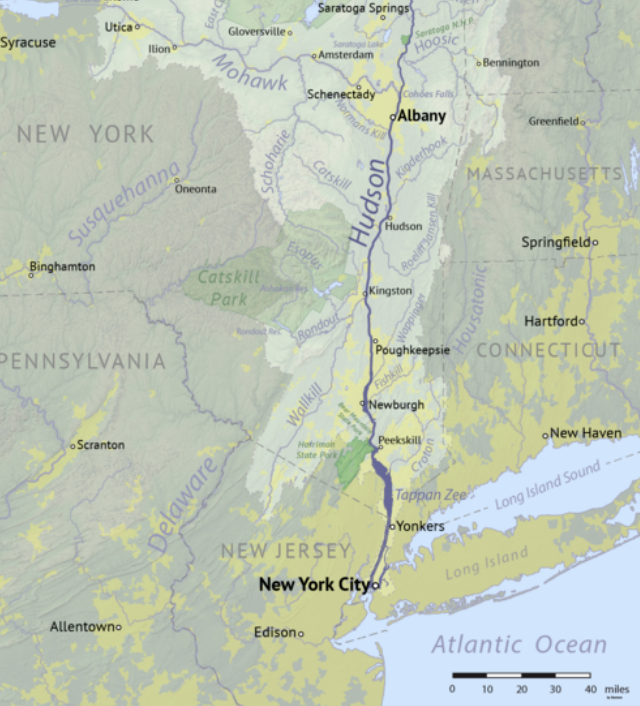
 In April of 2021, the Indian Point Energy Center, a nuclear power plant, located roughly 25 miles North of midtown Manhattan, closed down. The image below shows a summary of the Save The Hudson Act, a New York law passed in 2023 in order to prevent Holtec, the energy company that recently acquired the decommissioned plant, from dumping radioactive waste into the river.

However, Holtec took the State to court and in September 2025 a federal judge ruled in favour of Holtec, overturning the 2023 law and permitting it to dump 45 thousand gallons of radioactive waste water into the Hudson River.  This has largely gone unreported by major news outlets.

The Hudson river has a reputation of being a toxic body of water, especially as it flows past Manhattan and joins into the Atlantic Ocean.  However it also has a rich history of those who have dedicated their lives to protecting it. In the 60s, the Hudson River Fishermen’s Association was founded in response to a dying river that was the lifesource for many fishing communities. An amalgamation of industrial activity turned this vibrant river into a cesspool (literally). Until 1986, New York City was dumping around 150 million gallons of raw sewage into the river daily, millions of fish were dying each year as a result of Indian Point, General Motors was dumping paint  and the Penn Central Railroad was dumping oil and lubricants straight into the river. The fishing communities found their fish oily and tasting of diesel.

The Hudson River Fishermen’s Association, now renamed as Riverkeeper, has a rich history of not only conservation activities but also holding accountable and taking legal action against companies from Penn Central and General Motors to Exxon. A full timeline of all their actions can be found at the bottom of this page.

In 1976, the NY State’s Department of Environmental Conservation prohibited all fishing in the northern parts of the Hudson and banned almost all commercial fishing in the entire river due to a high prevalence of PCB.

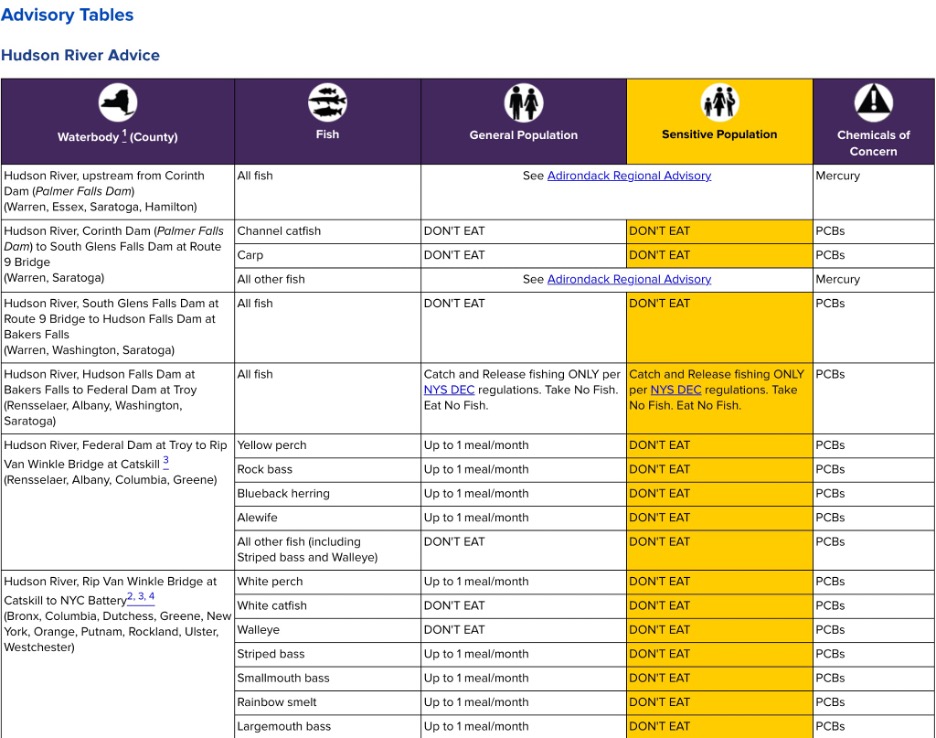
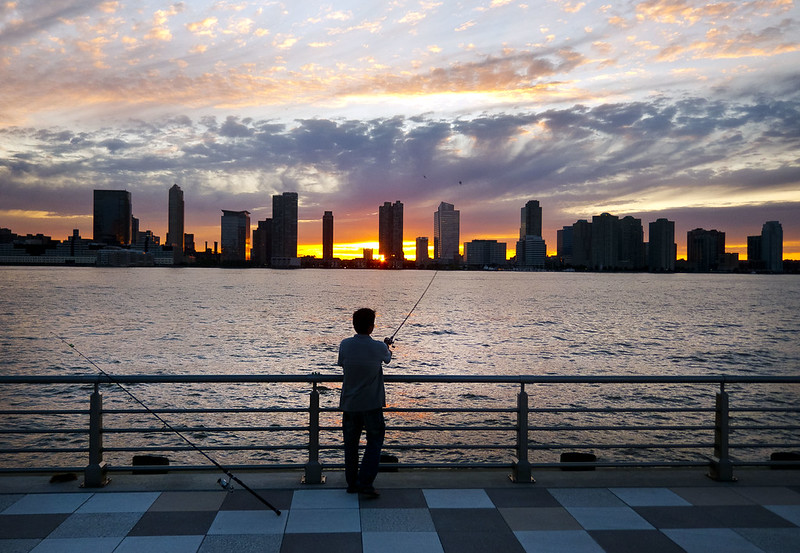
Today, when you pass along Riverside Drive, you can see people set up with their fishing lines. If you look at Google Maps going North up to the location of Indian Point, there are numerous marinas located in small towns that boast scenic boat days and fishing activities. The table below shows the current New York State Department of Health warning about the dangers of consuming fish from the river.   

In 2001, the campaign to close Indian Point began, with concerns regarding not only environmental contamination but also the fact the nuclear facility was located just 25 miles North of Manhattan. In a 2012 forum held at Columbia Law School, it was noted that Indian Point was responsible for killing over a billion aquatic organisms per year. The legal battles lasted until 2017 when Entergy, the company that owned the facility, agreed to shut down fully by 2021. In April of 2019, Entergy announced the sale of Indian Point to Holtec International, citing that Holtec better possessed the capacity to safely and efficiently decommission the site.

In contrast, Riverkeeper has labeled Holtec “the worst entity out there to do the job.” In 2010 the company faced bribery and corruption allegations that led to a two-month debarment as well as a $2 million administrative fee imposed by the Tennessee Valley Authority (TVA). The TVA’s Office of the Inspector General had claimed that Holtec made illegal payments to a TVA supervisor in return for a contract to build a storage system for spent nuclear fuel rods.

In 2014, the CEO of Holtec, Kris Singh, answered “no” on an application to the state of New Jersey asking if the applicant had ever been barred from business with a state or federal agency. The application was for a $260 million tax break for a new power plant.

Photo by Dan Nguyen

In 2023, Governor Kathy Hochul signed into law the Save The Hudson Act (the text is in the image above), preventing the discharge of any radiological substance into the Hudson River connected to the decommission of a nuclear power plant. This was in direct response to Holtec’s plans to dump radioactive wastewater into the Hudson. The passing of the law was widely celebrated and a massive win acknowledged by many. However, just this year on September 24th, the U.S. District Court for the Southern District of New York struck down the Save the Hudson Act as a result of a lawsuit that Holtec filed in April of 2024. The judge agreed that only the federal government has the authority to monitor radioactive discharge in relation to public and environmental safety. Holtec announced they were pleased with the decision saying, “We will continue to decommission the Indian Point site in an environmentally responsible manner working with local, state and federal stakeholders”. The governor has announced they will be appealing the decision, which will further delay Holtec’s plans.

The trajectory of environmental policy and protections under the Trump administration is grim. It feels as if a slide back into the days when General Motors could mainline car paint straight into the river is a possibility. The release of radioactive water into the Hudson, which will flow straight into the Atlantic ocean, is a huge hit to the conservation efforts and the river clean up that has been ongoing for years.

 
Samira Homerang Saunders is a Research Officer at the Centre for Climate Crime and Justice.