US aggression and Venezuelan oil

US aggression and Venezuelan oil: a climate analysis too crude

by David Whyte

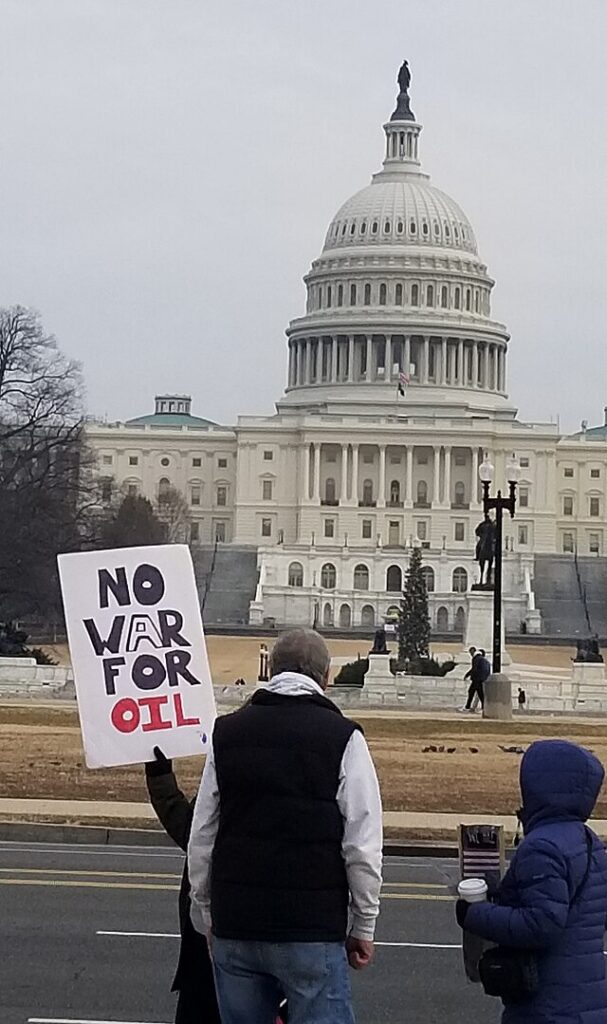
Protest at the US Capitol, 6th January 2026. Photo courtesy of Mike Licht


The kidnapping of Venezuelan President Nicolas Maduro on the 3rd January has prompted a number of commentators to rail against US aggression because of its likely impact on the climate crisis. 

The accusation is not, on first reading, contentious: the kidnapping is especially bad because it is clearly part of an attempt to pressure Venezuela to open US access to its oil – and therefore will be catastrophic for the climate.  Commentators and news outlets lined up to quantify the climate impact of the US capture of Venezuelan oil. Increasing Venezuelan production from 1 million barrels per day to 1.5 million would produce around 550 million tonnes of carbon dioxide a year when burned. The development of Venezuelan oil in the long term, according to ClimatePartner, US plans for Venezuela could end up consuming more 10% of the world’s carbon budget by 2050. Some even argued that the ramping up of the Venezuelan oil industry would breach the recent International Court of Justice agreement on the Paris Agreement. Along with those claims go explicit acknowledgements that Venezuelan oil is particularly dirty because of its very high carbon content.  The ‘heavy sour crude’ found in Venezuela’s Orinoco Belt is therefore even worse for the climate than other types of crude oil currently used by the US

None of this is really wrong.  On face value it is all plausible.  It is certainly the case that the US is trying to open up oil markets.  Indeed, it is probably also the case that US refinery infrastructure can deal with the particularly dense form of crude in Venezuela’s vast reservoirs, and US oil capital also has the capacity necessary to develop Venezuela’s infrastructure. 

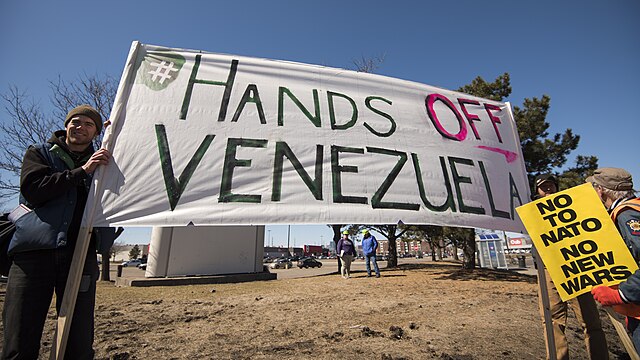
Photo courtesy of Fibonacci Blue

The problem with this approach is that those commentaries – by drawing attention to the climate impacts of this particular event – are very carefully showing a selective disdain for the events that have unfolded in Venezuela. The focus on the climate is presented as a separate issue to the violence of the US state.  It is presented as a separate issue and motivation from the Caribbean fishing boat assassinations, or indeed the US’s ongoing infiltration of Latin American politics and the fact that this is merely the latest episode in the CIA playbook.  Concern about ‘climate’ is a much safer terrain, and avoids alienating audiences that might be less inclined to oppose broader aims US domination in the region and across the globe.  In summary, those commentaries tend to take an easier route: they selectively attack the climate impacts of Trump’s Venezuelan mission. 

 Maybe it is easier to criticise the US for its climate policy than its policy of global domination through violence, particularly for a climate organisation.  NGO politics works very pragmatically in this sense.   Climate organisations and NGOs must pick their targets carefully since they are, by definition, single-issue campaigns.  They don’t tend to stray away from the comfort zone into areas of policy that their funders or supporters might not have signed up to.   This is how they raise money, how they bring influence to bear and this is how they recruit supporters: by staying focused on the single issue. Some, of course, are more willing to deliver wider political messages than others, but most try to keep to the single issue script.

 But the danger here is the danger of all single-issue campaigns: the same basic political problem is segmented in ways that means we can only see part of the picture.  The artificial segregation of competing issues stands in the way of a comprehensive understanding of the problem that faces us.

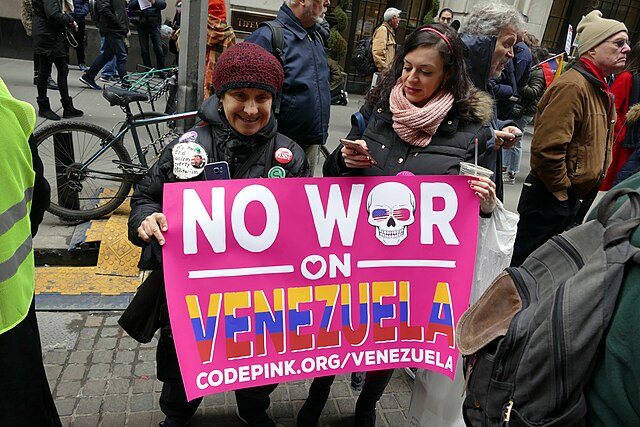
Demonstration at Trump Tower 2019. Photo courtesy of All-Nite Images

In this selective disdain for the Trump administration, the big picture is obscured.  This particular moment of state violence is ‘bad’ for the climate of course, but this is not the problem.  The problem is not the 50 million barrel oil deal, or the potential for faster exploitation of Venezuala’s oil. The kidnapping of the Maduros is merely one spectacular event in the US state’s 150-year long attachment to oil.  The big picture problem for the climate here is US imperialism. 

 This isn’t merely a “war for Venezuela’s oil” in a narrow sense. It is a war to defend the global interests of fossil capitalism in its entirety.  This intervention ultimately serves three critical purposes: protecting capital interests within the broader fossil economy, reasserting US imperial dominance in the Western Hemisphere by refusing to tolerate independent economic models, and defending the entire system of US fossil capitalism.

Like Iraq, the ultimate goal isn’t just to pump more crude. The goal is to dismantle a defiant state and reintegrate its vast resources into a US-dominated fossil fuel order. The target isn’t solely oil wells – or even whether Venezuelan oil is profitable or not – but the very principle of economic sovereignty that challenges American imperial power. The low level war in Venezuela, which may spread to Colombia and Cuba, is a war for the system itself, just like all of its military involvement in Gaza, in Sudan, or its domination of Greenland or its military presence across Asia.  All of this is to secure fossil capitalism. And this is the real reason US imperialism is ‘bad’ for the climate.

 
David Whyte is co-director of the Centre for Climate Crime and Justice.