


Was the Filton jury ‘nobbled’?
How the Filton 6 trial neutered the jury
by David Whyte
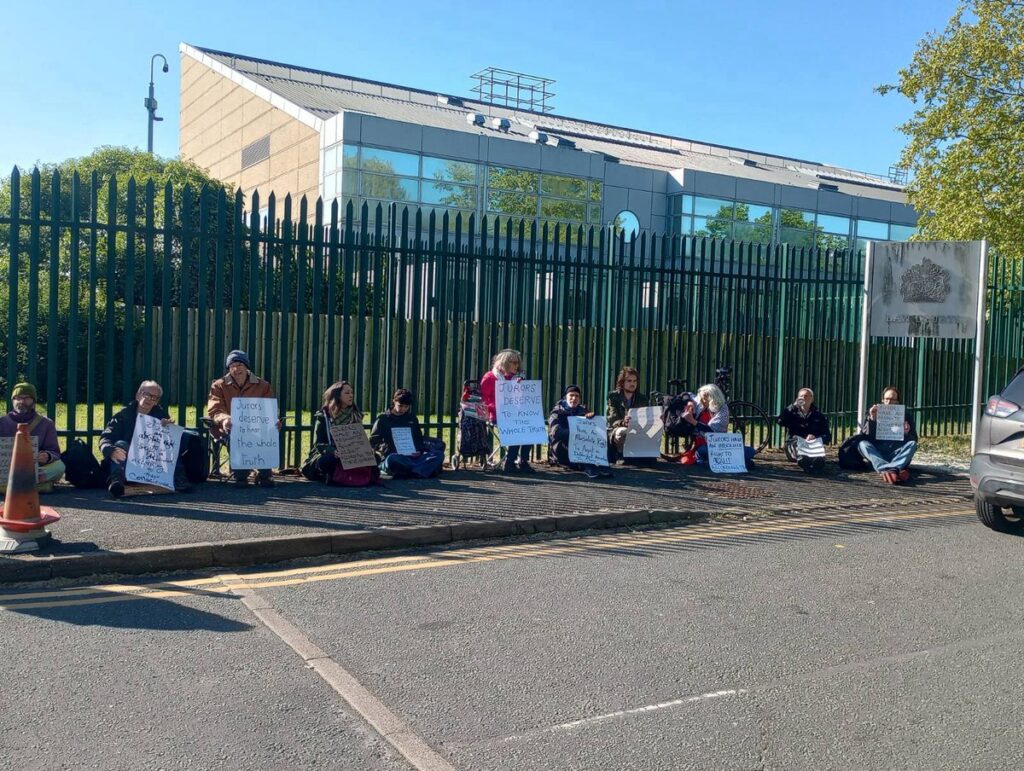
The Filton 6 trial will go down as one of the most remarkable in British criminal history. It will have this legacy because the judge in this case, Justice Jeremy Johnson ordered that a very long list of basic facts about the case had to be kept secret from the jury. He held a barrister in contempt of court and then ignored the prosecution by denying bail to the defendants in the case. On top of all of this the judge issued a gagging order that prevented anybody reporting his gagging orders! The reporting restrictions have now been lifted, meaning we can now reflect on what this means for British justice.
The Filton case put six Palestine Action activists who broke into an Elbit systems facility in Bristol and destroyed £1 million worth of military equipment on trial. This was the second trial in the case. On February the 4th they were acquitted of aggravated burglary by a jury at Woolwich Crown Court. Jurors also acquitted 3 defendants of violent disorder, and could not reach a verdict on all other charges (including criminal damage and Grievous Bodily Harm).
So what are the secret things Justice Johnson didn’t want us to know about? First, and perhaps most astonishing is that he ordered that the jury could not be told about the ‘terrorist connection’ to the charges. Under the Counter-Terrorism and Sentencing Act 2021, the court can decide to treat terrorism connection as an aggravating factor and therefore issue a much harsher sentence of up to 10 years in jail. Justice Johnson had ruled there was a ‘terrorist connection’ because activists sought to influence the Israeli government by physically limiting the arms available to them. This was deliberately concealed from the jury.
Why would the judge do this? Well no jury would credibly believe that a group of anti-war activists, protesting against the genocide in Gaza, were in fact committing an act of terrorism. And this is crucial, because it warped to jury’s awareness of the consequences of their decision. In the end jury convicted 4 defendants of a relatively minor offence of criminal damage. One was also convicted of a more serious offence of grievous bodily harm without intent. Crucially he was found not guilty of intending to harm.
Would the jury have taken this decision if they thought the protestors would be jailed for a long time for criminal damage and for unintentional injury? We will never know thank to this remarkable judicial intervention.
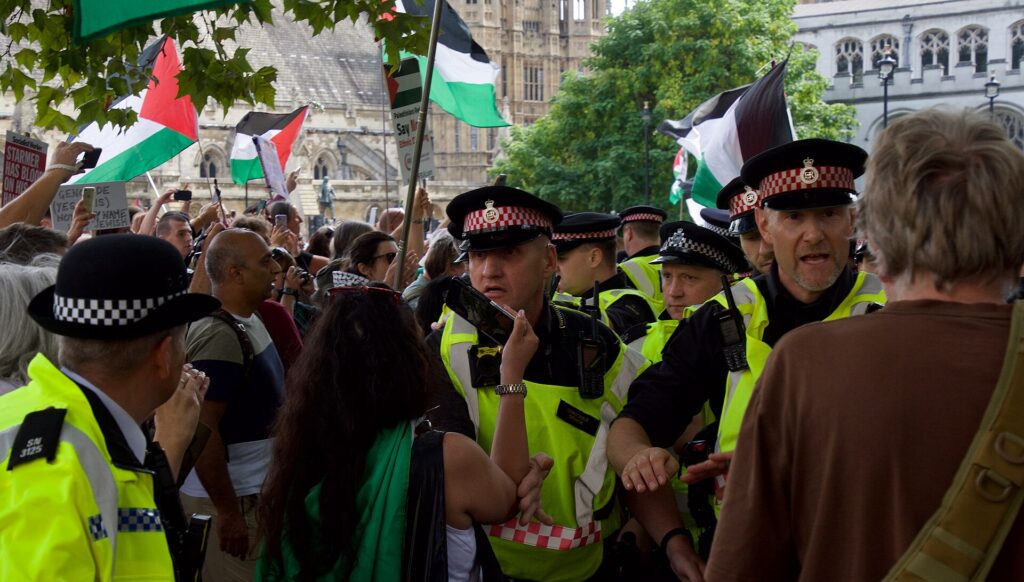
A second astounding feature of this case is that Justice Johnston ordered that the convicted protestors be held on remand despite the prosecution stating they should be released on bail. Three of the protestors have already spent 80 weeks on remand, a hugely inflated period of time that was recognised by their release after the February trial. The normal statutory limit even for the most serious offence is 26 weeks. As Defend Our Juries, co-publisher of our forthcoming report Britain’s Political Prisoners, has noted, the time they have served is effectively equivalent to almost four years in jail under sentencing guidelines (for causing criminal damage!). A fourth protrestor, Sam Comer, has been on remand for 91 weeks, and last week was convicted of GBH without intending to injure anyone.
Now those sentences can be dramatically increased because of the judge’s (not the jury’s) decision that they have a terrorism connection and they may be required to serve their entire sentence unless a parole board is persuaded that they have been “reformed” and no longer hold the beliefs that motivated their actions. In other words, they may be detained unless they renounce their opposition to the genocide in Gaza.
If this is not enough, have a look at the list of things that Justice Johnson ruled could not even be mentioned in in closing speeches by defence lawyers….They were not allow to refer to principle of jury equity (the legal principle that juries have the absolute right to acquit a defendant based on their conscience, even if they have no legal defence). They were not allowed to tell the jury that they should take into account the factory’s role in manufacturing weapons, or the fact the defendants didn’t intend to injure anyone, or the fact that security guards were violent, or the fact that defendants believed weapons were used to kill people and children, or the fact that defendants were previously acquitted for aggravated burglary and violent disorder, or the fact they were remanded in custody. They were not allowed to say they acted to save lives or prevent a greater crime or even mention the killing of Palestinians or the legality of Israel’s attacks on Gaza. Even more mundane facts about what they damaged and how it was damaged was ordered to be hidden from the jury.

This judge effectively demanded that the trial be conducted in secret, the most important information in the case withheld from the jury. This trial looks very much like the Diplock courts that were used to put suspected paramilitaries on trial in Belfast. In the Diplock courts, jury trials are formally removed for cases involving people designated as ‘terrorist’. They were abolished in 2007, but retained a power for the DPP to certify judge-only trials in exceptional cases. Those cases are still referred to as Diplock trial.
In the Filton 6 case the jury was neutered because key facts and the defences in the case were withheld from them. The effect is virtually the same as a Diplock court.
In the February trial, Rajiv Menon KC made a hugely powerful speech that made it clear that jurors are absolutely entitled to return verdicts according to their conscience. As we know, the jury didn’t convict his client or any of the other defendants of any offence in this, the first, trial of the Filton 6. Justice Jeremy’s response was extraordinary. He initiated contempt of court proceedings against Menon. Yesterday the Court of Appeal ruled that the Judge Jeremy had got above himself by taking the matter directly to the High Court rather than referring it to the Attorney General’s office. Rajiv Menon was the first barrister in living memory to face a contempt trial for things he said in his closing remarks.
On this evidence, Justice Jeremy Johnson might look like a rogue judge. But as our report Britain’s Political Prisoners will show, he is merely following a pattern of reactionary measures that large numbers of climate and Palestine solidarity activists have faced in court. There is something very rotten at the heart of the British court system and it is bringing the deeply political role of the judiciary into the open. When the courts must go to such bizarre lengths just to send a group of people who stood up against one of the worst atrocities of our time to jail, this is indeed a very precarious moment for British justice and for British democracy. And it hugely important context for current government proposals to further sabotage the jury system.