


The ICJ advisory opinion and climate politics
From political rupture to climate opportunity?
by Stefanie Khoury
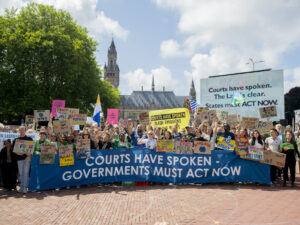
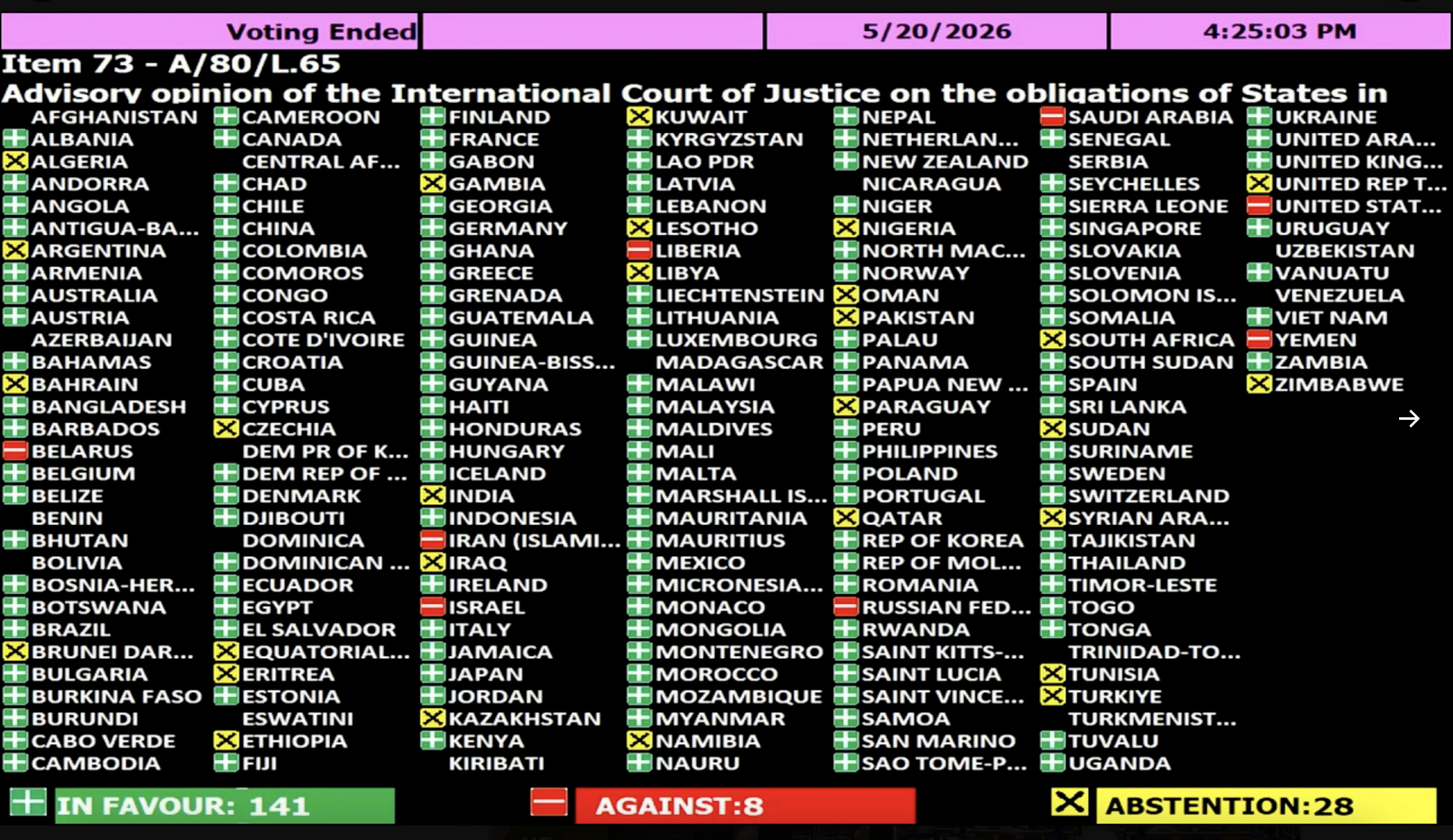
Last month, the UN General Assembly (GA) voted overwhelmingly to endorse last year’s landmark International Court of Justice’s (ICJ) Advisory Opinion on Climate Obligations. At that time, the World Court, as it is known, referred to “…the unprecedented challenge of civilizational proportions”(§1) that is climate change. With a margin of 141-8, the GA confirmed its support of the ICJ’s finding that states possess legal obligations to prevent catastrophic climate harm and that failure to act, or by omission, may entail legal consequences under international law. The Advisory Opinion is non-binding, but it provides a legal and moral compass for jurisdictions worldwide.
The GA’s Resolution is significant because it reveals a fracture in the international order: between the large majority of states demanding collective survival and a shrinking bloc of fossil-fuel powers determined to preserve geopolitical and economic dominance. All the usual suspects voted against the Resolution – the USA (the world’s largest historic greenhouse gas emitter), Russia, Belarus, Saudi Arabia, Iran, Israel, Yemen and more curiously Liberia; 28 countries abstained. The opposing states occupy different political positions, yet they share certain common features: each is deeply entangled in fossil extraction, or in geopolitical systems dependent upon preserving the existing global balance of power. The larger issue that this vote exposes, is how climate action has become a marker of the contradictions of the international political economy that supports unequal accumulation and unequal responsibility on a planetary scale.
The timing of the vote is also significant, arriving on the heels of the Santa Marta conference where nearly sixty countries agreed to pursue voluntary roadmaps for phasing out fossil fuel production outside the traditional UN consensus framework. The largest emitters including USA, China and Russia were not only absent, but were not invited. These recent developments in support of climate action, come after months of what appeared to be weakened resolve from governments; and, indicates not only a more forceful renewal of climate action momentum, but perhaps also that the world is beginning to imagine forms of governance that no longer depend upon the most powerful countries. The political philosopher, Antonio Gramsci argued that dominant powers maintain influence not only through military and economic force, but through leadership over institutions and norms. Seen in this light, the GA’s Resolution gestures towards a broader erosion of the political legitimacy of (former) superpowers, particularly in the domain of climate diplomacy.
Washington’s response was predictable. In its ‘explanation’, the USA claimed that there was “…no broad agreement among UN Member States about the merits of the Court’s Advisory Opinion”. The US ambassador to the UN described the resolution as “dangerous” for “…each States’ sovereign rights to regulate and manage its own energy policy”. Yet, this defence of sovereignty is deeply contradictory. The USA has repeatedly subordinated the sovereignty of other nations when doing so served strategic or economic interests. Through sanctions regimes, IMF conditionality, military intervention, and trade coercion, the USA has long constrained the developmental autonomy of other states. In climate politics specifically, Global South governments have often argued that wealthy powers demand environmental discipline abroad while protecting extractive industries at home.
That is part of why the lonely eight “no” votes matter; their defensive posture is revealing. They are no longer seen as leaders shaping international consensus, but as holdouts attempting to delay an emerging norm. It is worth also commenting on the abstentions. Abstaining states, including several major fossil producers, appeared reluctant to fully endorse the opinion but equally unwilling to openly oppose an emerging global norm. The eight opponents instead formed a hard core of resistance to climate accountability itself. Their isolation is striking. Even within the fragmented geopolitics of the 2020s, they could not build a broader coalition against the resolution.
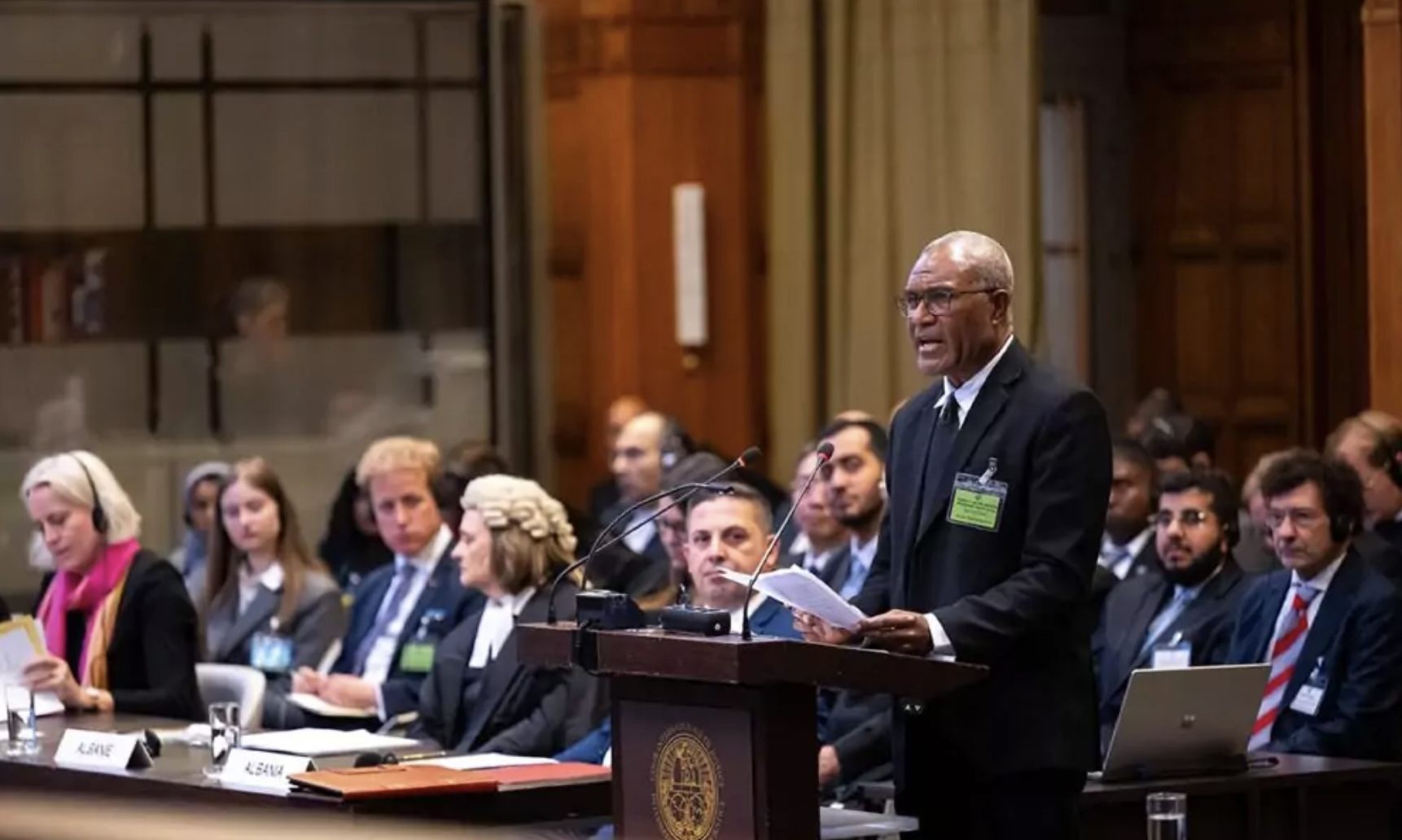
This raises the central question: is the world finally ready to move on without the USA at the centre of climate governance? Economically and militarily, probably not entirely. The USA remains central to global finance, energy markets, and technological infrastructure. But politically, the answer increasingly appears to be yes. The Santa Marta Conference, led by Global South states, was clearly a move towards a post-hegemonic climate politics where coalitions of vulnerable states and regional blocs bypass deadlocked institutions. The ICJ process was driven not by major powers but by Pacific Island states, led by Vanuatu, which also spearheaded the General Assembly resolution, signalling a redistribution of moral authority within international relations.
Climate breakdown has breached Earth’s planetary boundaries and has exposed the inability of existing institutions to reconcile endless accumulation with ecological survival. The ICJ’s Advisory Opinion therefore represents more than legal clarification; it forms part of a wider struggle over whether international law serves entrenched economic power or collective human survival. Of course, international law has historically accommodated capital and courts have done little to confront systemic material inequalities. So, there remains a real danger that symbolic victories may substitute for structural transformation. That said, this landslide 141-8 vote sends a strong message that climate justice commands global legitimacy, even if enforcement remains weak.
The deeper implication is that the centre of political and legal imagination may be shifting away from the traditional hegemonic core. The ICJ opinion, the Santa Marta Conference, and the General Assembly vote together suggest the possibility of a new alignment. Whether that becomes a genuinely transformative project or merely another reconfiguration of global capitalism remains uncertain. But one reality is increasingly difficult to deny: the world no longer believes that climate action and justice can wait for Washington’s permission.